Physical controls, exact feedback
Buttons select sources and filters. Knobs rotate through 270° and redraw Hz, Q, dB, or playback-rate labels as they move.
Interactive Graphics course project
An interactive, audio-reactive city where sound becomes architecture: hear a signal, shape it, and watch its waveform and frequency spectrum respond in the same explorable 3D scene.
Overview
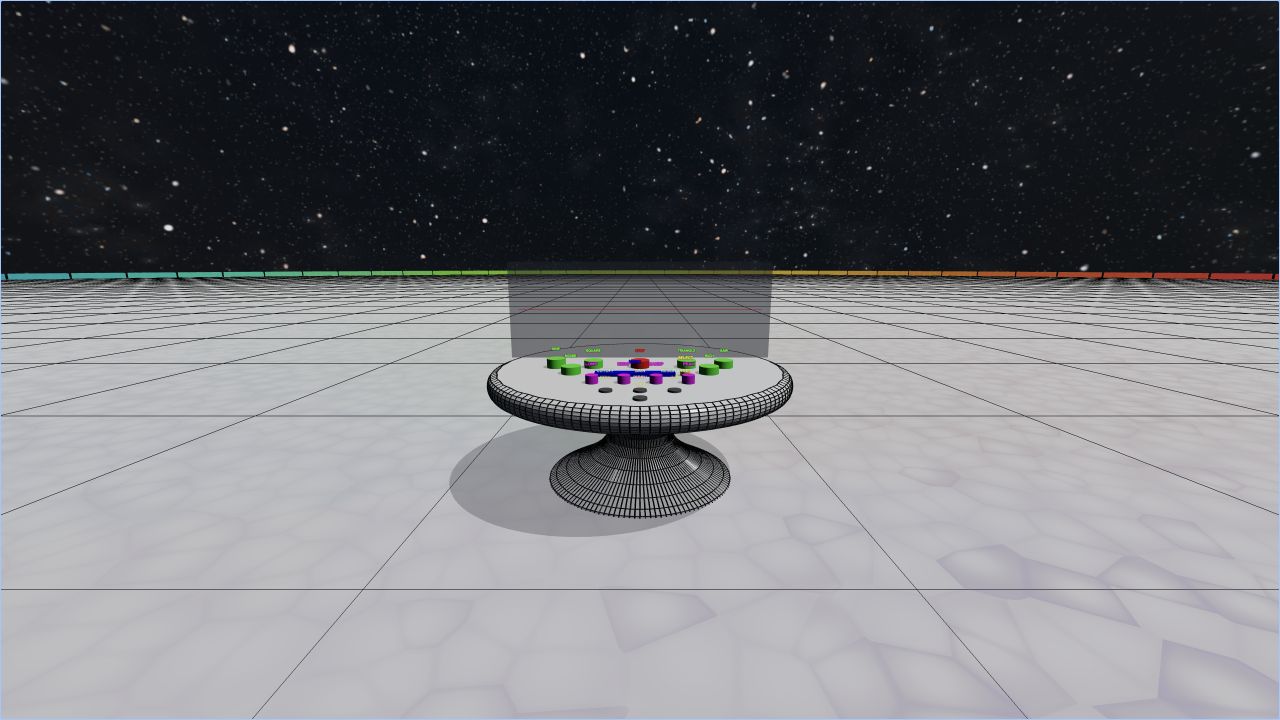
Fourier City turns signal-processing concepts into visible behavior. The live waveform answers how amplitude changes over time; the skyline answers where energy is distributed across frequency. In-world controls let visitors change the sound and compare both views immediately.
The experience supports generated sine, square, triangle, sawtooth, rich-harmonic, and noise signals, plus a bundled or user-selected MP3. Pitch, cutoff, gain, and resonance are changed directly on the 3D desk rather than through a separate menu.
Core principle: the waveform and FFT analyse the same post-filter signal that reaches the listener, so the audible and visual responses stay aligned.
Experience
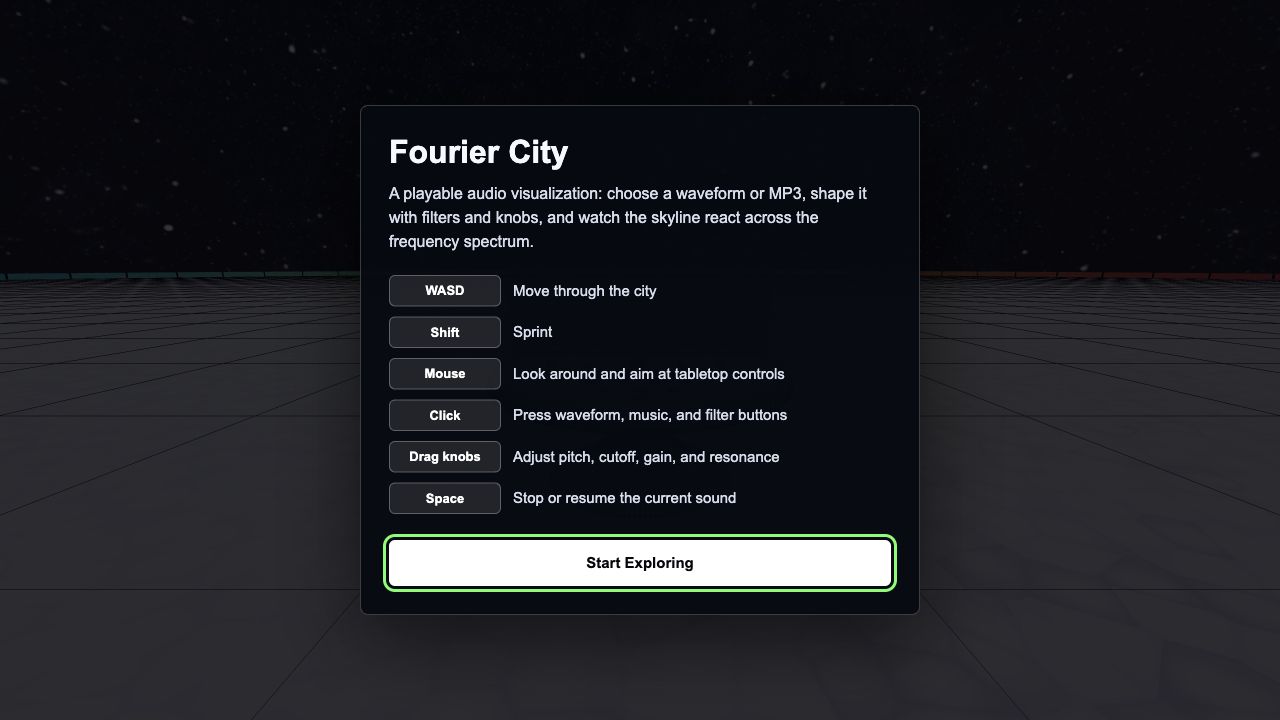
The camera uses a first-person viewpoint. The table and robot are physical obstacles, while blocked diagonal movement slides along their edges to keep exploration fluid.
Buttons select sources and filters. Knobs rotate through 270° and redraw Hz, Q, dB, or playback-rate labels as they move.
A glass display plots 2,048 post-filter samples and begins near a rising zero crossing so periodic waveforms remain visually stable.
Position and hue identify frequency; building height, line brightness, and ground motion identify spectral energy.
For periodic signals, a two-link robotic arm points to the skyline band matching the selected pitch and follows that building’s roof.
Audio pipeline
MP3 buffers and procedural sources share one controller. Periodic waveforms use live oscillators for smooth pitch changes; noise and music use looping buffers. A selected biquad filter is inserted before analysis and positional output.
A normalized knob value maps evenly across the audible range for periodic oscillators.
f(p) = 20 × (20000 / 20)p Hz, 0 ≤ p ≤ 1
Music instead maps pitch to a playback rate from 0.5× to 1.5×; noise has no single pitch.
Cutoff spans 20 Hz to 20 kHz, resonance spans Q = 0.1 to 20, and the peaking filter adds gain from -18 to +18 dB.
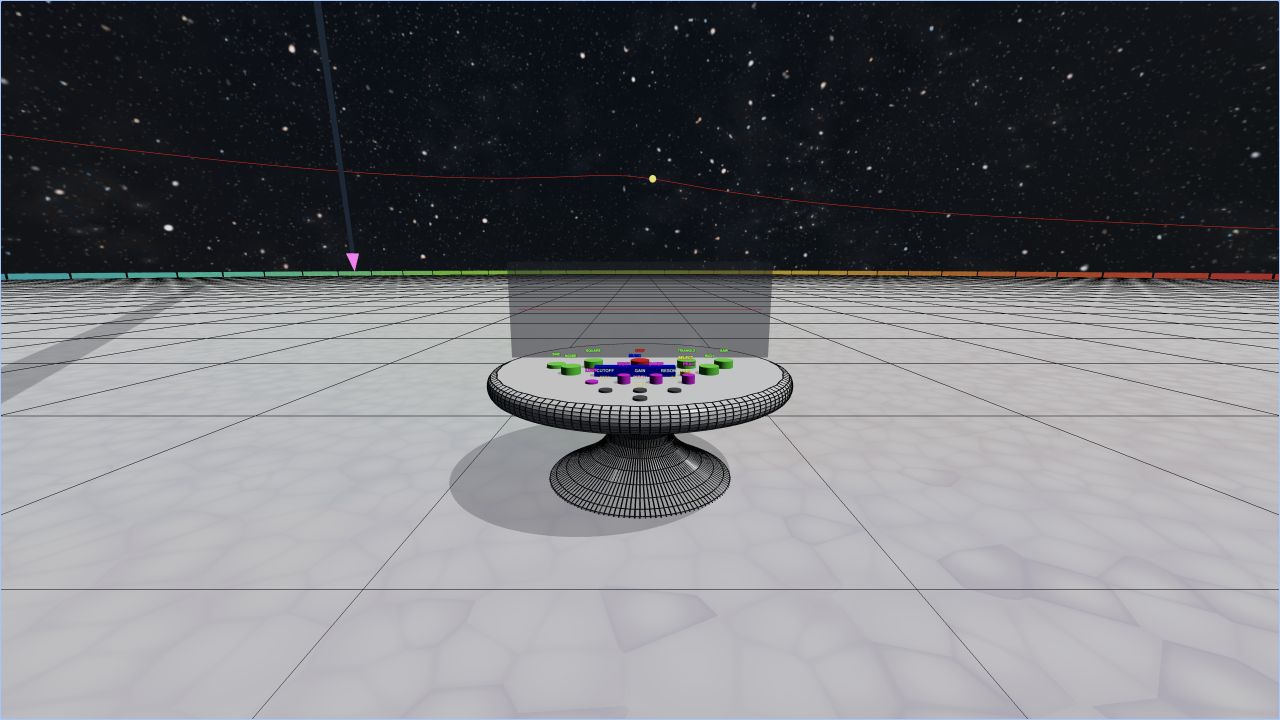
The red skyline curve predicts attenuation or emphasis while a yellow marker identifies cutoff.
Spectrum city
A 2,048-point FFT is sampled at 30 Hz and grouped into 70 logarithmic bands from 20 Hz to 20 kHz. Mean decibels in each band are normalized into a common energy value used by buildings, wireframes, and the shader-driven ground flow.
Separate exponential rates make buildings react quickly to rising energy and fall more slowly during decay. The same smoothed scale drives the solid building and its colored wireframe.
α = 1 - e-rΔt · rise r = 200 · decay r = 16
Band energy controls building height, wireframe brightness, and a compact 70-texel texture sampled by the ground shader. Color preserves frequency identity across every layer.
Hierarchical animation
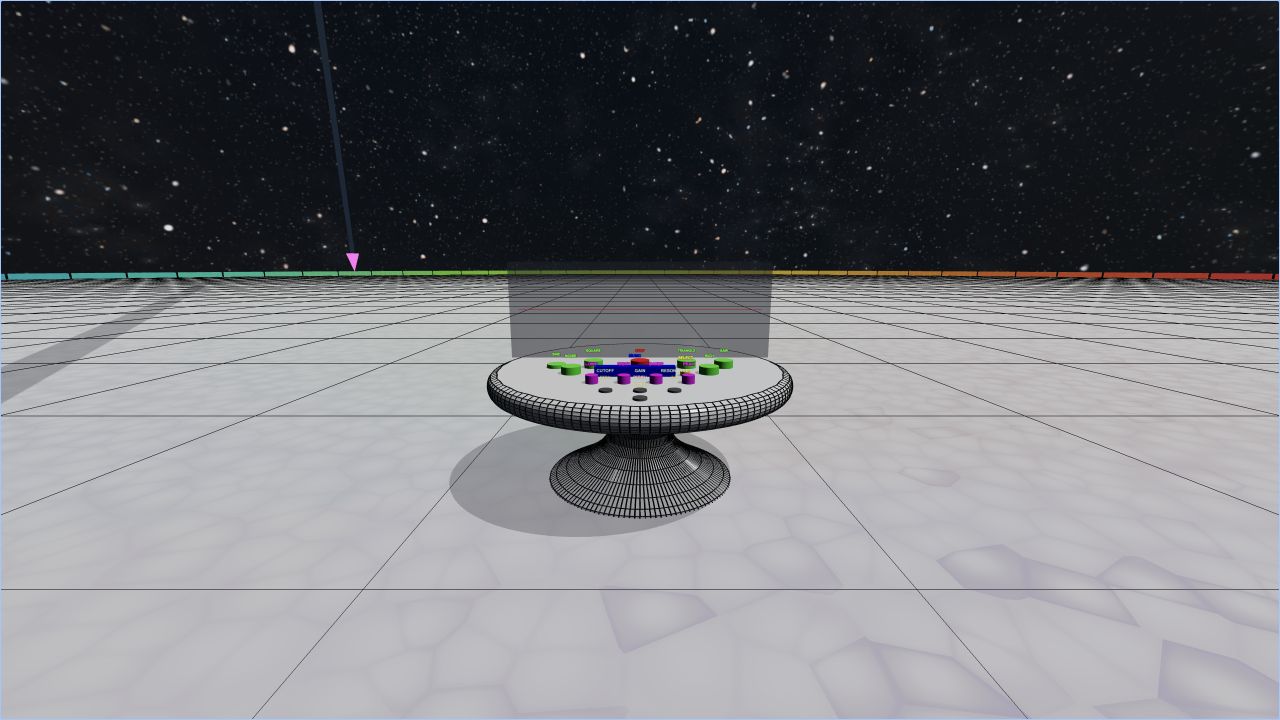
The arm is a nested Three.js hierarchy. Base yaw chooses the movement plane; shoulder and elbow solve reach; the wrist compensates to preserve stylus orientation. Every child inherits the transformations of the joints above it.
Periodic oscillator pitch is rounded to the nearest skyline band. MP3 playback rate and noise do not represent one stable frequency, so the robot returns smoothly to its folded inactive pose.
The target distance is clamped to the reachable interval before the joint angles are solved, preventing invalid poses when the selected building lies outside the exact arm radius.
θ₂ = acos((d² - L₁² - L₂²) / (2L₁L₂))
θ₁ = atan2(y, x) - atan2(L₂sinθ₂, L₁ + L₂cosθ₂)
wrist = -(θ₁ + θ₂)
Engineering
The scene uses performance techniques selectively: every optimization also protects the clarity of a visual explanation that must update continuously with audio.
The original Blender skyscraper is normalized and reused with instancing. Expanded line buffers keep each wireframe synchronized with its solid building.
Typed arrays, analyser buffers, matrices, and waveform geometry are updated in place to avoid per-frame allocations.
A small RGBA texture carries band energy to a polar ground shader with traveling waves, Voronoi edges, Fresnel response, and specular highlights.
Versioned audio requests ignore stale MP3 callbacks; analytic collisions, pointer-lock recovery, and lazy audio setup keep the experience predictable.
Next steps: add band-stop filters, microphone and streamed sources, selectable FFT sizes, keyboard-accessible controls, saved presets, and lower-detail modes for weaker devices.
Gallery
Credits and resources
Fourier City was created by Lorenzo Marinelli and Alessandro Romania for the Interactive Graphics course taught by Prof. Marco Schaerf at DIAG, Sapienza University of Rome. The table and skyscraper OBJ models are original team assets made in Blender.
The environment uses Night Sky HDRI 001 from ambientCG under CC0 1.0. Three.js and Vite are used under their published open-source licenses. Full technical references and implementation details are listed in the report.